
How to Spot and Respond Safely
Biohazards are not only found in research labs. They can also show up in offices, schools and even homes. If you work around blood or body fluids, learn what the biohazard symbol on a door means. This post explains biohazards in simple words. It shows you how to handle them safely. It also shares a few safety trends to watch in 2025.
Why talk about safety in 2025?
Safety rules change as work changes. A list of 2025 Safety Moment Ideas urges short talks on many topics. alertmedia.com These include staying aware, finding escape routes, handling chemicals, reporting injuries and wearing safety gear. alertmedia.com More people now work from home or split time between work sites. This means hazards can appear in many places. Short safety talks keep people thinking about these risks. alertmedia.com
What is a biohazard?
A biohazard is a living thing or product that can harm peopleoshaeducationcenter.com. These include germs like bacteria, viruses, fungi and parasitesoshaeducationcenter.com. They also include blood, spit, urine, animal waste, decaying plants and even insect bitesoshaeducationcenter.com. You can get infections or allergies by touching or breathing these hazardsoshaeducationcenter.com.
Types of biological hazards
OSHA groups biohazards into a few simple typesoshaeducationcenter.com. The table below lists them with examples and a quick safety tip.
| Type | Examples | Safety tip |
|---|---|---|
| Germs | Bacteria, viruses, parasites and molds. oshaeducationcenter.com | Wear gloves and masks and wash your hands |
| Toxins | Natural poisons like botulinum toxin. oshaeducationcenter.com | Avoid contact and use special containers |
| Blood & sharps | Used needles, scalpels, blood, saliva and vomit. oshaeducationcenter.com | Throw sharps into hard containers and do not recap needles. cdc.gov |
| Animal & plant waste | Animal droppings, sewage and rotten plants. oshaeducationcenter.com | Wear gloves and masks and work in fresh air |
| Insects | Bees, mosquitoes and ticks. oshaeducationcenter.com | Use bug spray and cover exposed skin |
How infection spreads?
Germs spread in a chain. Six links must line up. oshaeducationcenter.com:
- Agent: the germ itself.
- Reservoir: where the germ lives, like blood or a surface.
- Exit: how it leaves the reservoir, like a cough or cut.
- Transmission: how it travels, for example by touch or through the air. oshaeducationcenter.com
- Entry: how it gets into a new person, like through broken skin or breathing. oshaeducationcenter.com.
- Host: someone who can get sick. oshaeducationcenter.com.
If you break one link, the chain stops. Washing your hands, wearing gloves, cleaning surfaces or getting vaccinated are all ways to break links.
Reading biohazard symbols and signs:
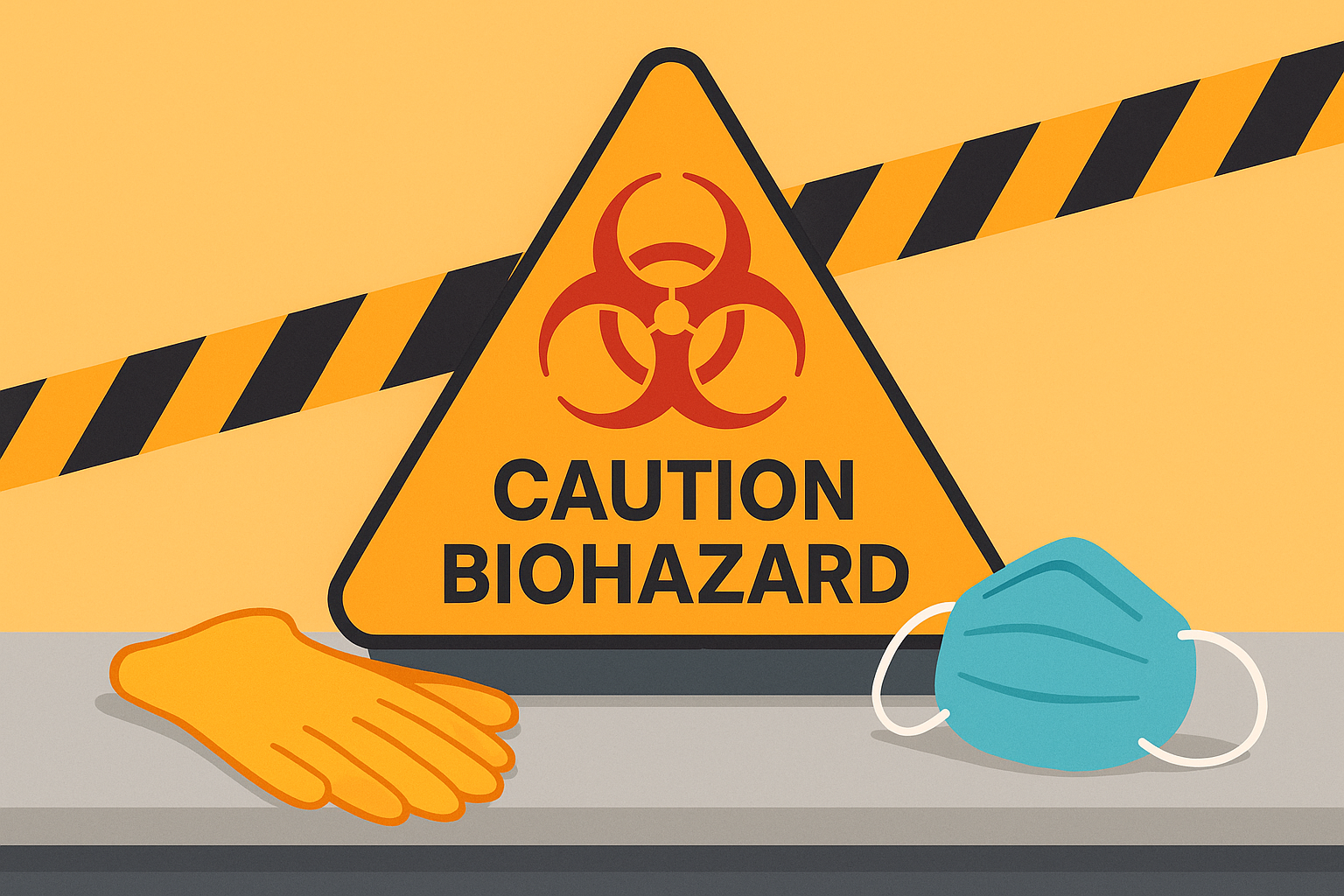
The biohazard symbol looks like three rounded shapes in a circle. It sits on a bright orange or red background. An engineer named Charles Baldwin designed it in 1966 so people all over the world could recognize it. medxwaste.com You will see this symbol on bags, doors, and containers that hold dangerous biological material. medxwaste.com Its job is to warn you to use care. medxwaste.com
OSHA’s Bloodborne Pathogens Standard says you must put this label on any container that holds blood or other infectious waste. researchsafety.gwu.edu Lab doors also need a biohazard warning sign. The sign lists the germs inside, what safety gear to wear and who to call in an urgent situation. researchsafety.gwu.edu Labs that work with infectious agents from Levels 1 through 3 must post this sign. researchsafety.gwu.edu

How to handle and throw away biohazards:
Handle dangerous waste the right way. waste the right way. The CDC says most lab waste is no more risky than regular trash. But sharps and cultures can be dangerous. cdc.gov
Follow these steps:
- Put sharps in hard containers. Drop needles and blades into a puncture‑proof box right away. Never recap or bend needles. cdc.gov
- Bag other waste. Use strong, leak‑proof bags with the biohazard symbol. If a bag tears, put it into another bag and tie both closed. cdc.gov
- Label and store safely. Keep waste in a sealed, labelled container in a place with good air flow. Do not let it pile up. cdc.gov
- Treat before disposal. Sterilize waste with heat (autoclaving), chemicals or special machines before throwing it away. cdc.gov
- Many sharps and cultures need to be sterilized on site. cdc.gov
- Follow the law. Local and national rules explain how to handle each type of waste. cdc.gov
- Make a waste plan and train your team!
What to do if there is a spill:
Accidents happen. Having a plan helps you stay calm and safe. Use these steps, based on guidance from Hazmat School and Cornell University: hazmatschool.comehs.cornell.edu
- Warn others. Tell people near you to leave the area. hazmatschool.com.
- Check the risk. Look at the type and amount of material. If it is large or very dangerous, call 911 and your manager. hazmatschool.com
- Protect yourself. Put on gloves, a mask and other gear from a spill kit. hazmatschool.com
- Stop and contain. Find the source of the spill and stop it if you can. Block drains and surround the spill with absorbent pads. hazmatschool.com
- Clean and disinfect. Use pads to soak up the material and clean the area with the right cleaner. hazmatschool.com
- In labs, let any airborne droplets settle for at least 30 minutes and pour cleaner over the spill. Wait 15 to 20 minutes before wiping. ehs.cornell.edu
- Tell someone. Report the spill to your manager and fill out any required forms. hazmatschool.comehs.cornell.edu
- Know your limits. Do not try to clean up large spills, very toxic substances or spills in areas without fresh air. Call trained responders! hazmatschool.com
Training and building a safety culture:
People are the most important part of any safety plan. OSHA points out that training is the best way to prevent exposure to biohazards. oshaeducationcenter.com Workers should know how to spot hazards and use safety gear. oshaeducationcenter.com They should follow exposure rules and act fast in an urgent situation. oshaeducationcenter.com Regular drills help keep these skills sharp. Organizations often provide special training and practice for spills. ehs.cornell.edu
A strong safety culture grows when leaders encourage questions, share updates and recognize safe habits. In 2025, new concerns are part of the talk. They include home office safety, climate‑related hazards, wearable safety tech, and mental health. alertmedia.com Stay informed about new trends and share them in short safety talks. This way everyone stays ready.
Quick takeaways
- Biohazards include germs, toxins, body fluids, animal waste, plant waste and insects. oshaeducationcenter.com
- The biohazard symbol warns you to use care around infectious materials. medxwaste.com
- Sharps go in puncture‑proof containers, and you should never recap needles. cdc.gov
- If there is a spill, warn others, protect yourself, stop the spill, clean it up and report the incident. hazmatschool.com
- Training and regular safety talks keep people ready and help build a culture of safety. oshaeducationcenter.com
After these simple steps will help you handle biohazards safely. This will reduce the chance of accidents at work or at home.
When to call in the experts?
You can handle small spills if you have training and proper gear. But you should call an expert for bigger jobs. Examples include:
- Large spills and crime scenes-When there is a lot of blood or a messy accident.
- Hoarding or decay-When a home is unsafe.
- When there is an undiscovered death-Someone passed without others knowing.
- Suicide or trauma scenes-Sensitive events that need care and respect.
Bio‑One Highlands offers compassionate assistance to families during challenging times. They offer specialized cleaning services for scenes that others may be unable or unwilling to handle. Their team arrives promptly and operates with utmost discretion, ensuring a discreet and professional approach. Bio‑One Highlands operates 24/7, providing round-the-clock support. They are equipped to use unmarked vehicles and collaborate with insurance companies. As a locally owned and trusted company, Bio‑One Highlands is committed to delivering exceptional service. For a compassionate cleanup, contact Bio‑One Highlands.